Tuesday, 27 June 2017

Crude oil prices extend bounce off 10-month lows - Sean Seshadri

Oil prices were higher in European trade on Tuesday, extending their recovery from last week's ten-month lows, but futures stayed volatile in the face of fresh supply worries amid indications that U.S. shale production will continue to rise.
The U.S. West Texas Intermediate crude August contract was at $43.72 a barrel by 3:25AM ET (0725GMT), up 35 cents, or around 0.8%. It touched its lowest since August 11 at $42.05 on Wednesday last week.
Elsewhere, Brent oil for September delivery on the ICE Futures Exchange in London tacked on 39 cents to $46.43 a barrel, after hitting $44.35 last Wednesday, a level not seen since November 14.

© Reuters.  Crude oil prices extend bounce off 10-month lows
Oil settled higher Monday, tallying their third straight session of gains, despite ongoing pressure from expectations of further growth in U.S. output.
U.S. drillers last week added rigs for the 23rd week in a row, according to data from energy services company Baker Hughes, implying that further gains in domestic production are ahead.
The increase in U.S. drilling activity and shale production has mostly offset efforts by OPEC and other producers to cut output in a move to prop up the market.
In May, OPEC and some non-OPEC producers extended a deal to cut 1.8 million barrels per day in supply until March 2018.
Investors looked ahead to weekly data from the U.S. on stockpiles of crude and refined products.
Industry group the American Petroleum Institute is due to release its weekly report at 4:30PM ET (2030GMT) later on Tuesday. Official data from the Energy Information Administration will be released Wednesday, amid forecasts for an oil-stock drop of around 2.2 million barrels.
Elsewhere on Nymex, gasoline futures for August inched up 0.1 cents to $1.435 a gallon, while August heating oil gained 0.9 cents to $1.395 a gallon.
Natural gas futures for August delivery rallied 2.6 cents to $3.075 per million British thermal units.

Thursday, 22 June 2017

Oil edges up, but still set for worst first-half performance in 20 years - Sean Seshadri

Oil edged up on Friday, recovering some of the steep falls earlier in the week, but crude is still set for the worst first-half decline in two decades despite ongoing production cuts.
Brent crude futures (LCOc1) were at $45.39 per barrel at 0501 GMT, up 17 cents, or 0.4 percent, from their last close.
U.S. West Texas Intermediate (WTI) crude futures (CLc1) were up 17 cents, or 0.4 percent, at $42.91 per barrel.
Oil prices have fallen about 20 percent this year despite an effort led by the Organization of the Petroleum Exporting Countries (OPEC) to cut production by 1.8 million barrels per day (bpd) that has been in place since January.
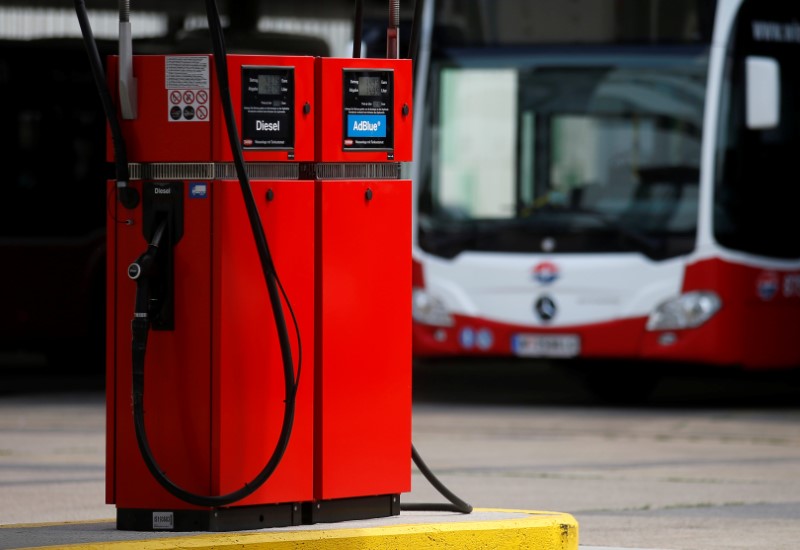
© Reuters. A diesel oil pump is seen at a bus terminal in Vienna
That's the worst first-half performance for crude oil since 1997, when rising output and the Asian financial crisis led to sharp price falls.
The weak markets are a result of doubts over OPEC's ability to rein in a fuel supply overhang that has dogged markets since 2014 as production has largely outpaced consumption.
"Markets remain skeptical of OPEC's ability to balance supplies," ANZ bank said on Friday.
At the heart of the glut is that recent efforts to reduce production from the traditional suppliers of OPEC and Russia has been met by soaring output from the United States.
Thanks largely to shale drillers, U.S. oil production has risen by more than 10 percent over the last year to 9.35 million bpd, close to the level of top exporter Saudi Arabia.
Excess production has left storage tanks around the world bloated.
"Inventories through April are up 80m (million barrels) since the beginning of the year, raising market concerns about the efficacy of OPEC market management," U.S. investment bank Jefferies said.
"We remain of the view that inventories will draw by 1.5 million bpd in the second half (of 2017), but empirical evidence of this is likely necessary for oil prices to inflect into an upward trend," it added.

Wednesday, 21 June 2017

Oil struggles near multi-month lows ahead of U.S. supply update - Sean Seshadri

Oil prices struggled near multi-month lows in European morning trade on Wednesday, as investors looked ahead to weekly data from the U.S. on stockpiles of crude and refined products later in the global day.
Markets had a muted reaction to news that Saudi Arabia has relieved Muhammad bin Nayef as crown prince, replacing him with Mohammad bin Salman.
The U.S. West Texas Intermediate crude August contract was at $43.49 a barrel by 3:10AM ET (0710GMT), down 2 cents. The U.S. benchmark fell to its lowest since November 14 at $42.94 in the prior session.
Elsewhere, Brent oil for August delivery on the ICE Futures Exchange in London dipped 7 cents to $45.95 a barrel, after hitting $45.42 a day earlier, a level not seen since November 15.
© Reuters.  Oil struggles near multi-month lows
Oil prices lost around 2% on Tuesday, falling into bear market territory, as concerns over a steady increase in U.S. production added to fears over a glut in the market.
The U.S. Energy Information Administration will release its official weekly oil supplies reportat 10:30AM ET (1430GMT) Wednesday.
Analysts expect crude oil inventories dropped by around 2.1 million barrels at the end of last week, while gasoline supplies are seen increasing by 443,000 barrels and distillates are forecast to gain about 465,000 barrels.
After markets closed Tuesday, the American Petroleum Institute said that U.S. oil inventories fell by 2.72 million barrels in the week ended June 16.
The API report also showed a gain of 346,000 barrels in gasoline stocks, while distillate stocks rose by 1.837 million barrels.
There are often sharp divergences between the API estimates and the official figures from EIA.
Oil prices have been under pressure in recent weeks as concern over rising U.S. shale output offset production cuts by OPEC and non-OPEC members.
U.S. drillers last week added rigs for the 22nd week in a row, extending a year-long drilling recovery to the highest level since April 2015, implying that further gains in domestic production are ahead.
The increase in U.S. drilling activity and shale production has mostly offset efforts by OPEC and other producers to cut output in a move to prop up the market.
Last month, OPEC and some non-OPEC producers extended a deal to cut 1.8 million barrels per day in supply until March 2018.
So far, the production-cut agreement has had little impact on global inventory levels due to rising supply from producers not participating in the accord, such as Libya and Nigeria.
Elsewhere on Nymex, gasoline futures for July inched up half a cent to $1.423 a gallon, while July heating oil added lost 0.4 cents to $1.394 a gallon.
Natural gas futures for July delivery ticked down 0.9 cents to $2.897 per million British thermal units.
Monday, 19 June 2017

Oil prices start the week lower amid relentless increase in U.S. drilling - Sean Seshadri

Oil prices were under slight pressure in European trading on Monday, holding near the lowest in around seven weeks as concerns over a steady increase in U.S. production added to fears over a glut in the market.
The U.S. West Texas Intermediate crude July contract was at $44.77 a barrel by 3:35AM ET (0735GMT), down 19 cents, or around 0.4%. Elsewhere, Brent oil for August delivery on the ICE Futures Exchange in London shed 14 cents to $47.23 a barrel.
WTI lost $1.13, or about 2.4%, last week, while Brent fell 78 cents, or roughly 1.6%.
Both have now posted losses four weeks in a row, which marks the longest weekly losing streak since August 2015 for WTI, amid concern that the ongoing rebound in U.S. shale production is derailing efforts by other major producers to rebalance the market.
© Reuters.  Oil prices start the week lower
Energy services company Baker Hughes said on Friday that U.S. drillers last week added rigs for the 22nd week in a row, the longest such streak on record, implying that further gains in domestic production are ahead.
The U.S. rig count rose by six to 747, extending a year-long drilling recovery to the highest level since April 2015.
The increase in U.S. drilling activity and shale production has mostly offset efforts by OPEC and other producers to cut output in a move to prop up the market.
Last month, OPEC and some non-OPEC producers extended a deal to cut 1.8 million barrels per day in supply until March 2018.
So far, the production-cut agreement has had little impact on global inventory levels due to rising supply from producers not participating in the accord, such as Libya and Nigeria, and a relentless increase in U.S. shale oil output.
In the week ahead, market participants will eye fresh weekly information on U.S. stockpiles of crude and refined products on Tuesday and Wednesday to gauge the strength of demand in the world’s largest oil consumer.
Meanwhile, traders will also continue to pay close attention to comments from global oil producers for evidence that they are complying with their agreement to reduce output this year.
Elsewhere on Nymex, gasoline futures for July was little changed at $1.454 a gallon, while July heating oil dipped half a cent to $1.420 a gallon.
Natural gas futures for July delivery slumped 8.3 cents to $2.954 per million British thermal units.

Friday, 16 June 2017

Gold prices edge higher but hover near 3-week trough - Sean Seshadri

Gold prices edged higher on Friday, but were still hovering near a three-week trough as the greenback remained broadly supported after recent upbeat U.S. data and the Federal Reserve’s decision to raise interest rates.
On the Comex division of the New York Mercantile Exchange, gold futures for August delivery were up 0.14% at $1,256.40.
The August contract ended Thursday’s session 1.67% lower at $1,254.60 an ounce.
Futures were likely to find support at $1,250.90, the low of May 24 and resistance at $1,268.50, Thursday’s high.
The greenback gained ground after the release on Thursday of encouraging data on U.S. initial jobless claims, as well as on manufacturing activity in the Philadelphia and New Yorkareas.
The data came a day after the Fed raised interest rates from 1.00% to 1.25%, in a widely expected move.
Gold moves higher but gains seen limited
However, disappointing U.S. inflation data released the same day raised questions about whether the central bank will be able to hike rates again later this year.
On Friday morning, the U.S. dollar index, which measures the greenback’s strength against a trade-weighted basket of six major currencies, was steady at 97.44, close to Thursday’s two-week high of 97.56.
Gold is sensitive to moves higher in both U.S. rates and the dollar. A stronger dollar makes gold more expensive for holders of foreign currency while a rise in U.S. rates, lift the opportunity cost of holding non-yielding assets such as bullion.
Market participants were now looking ahead to U.S. housing sector and consumer sentiment, due later Friday for further indications on the strength of the economy.
Elsewhere in metals trading, silver futures for July delivery edged up 0.13% to $16.737 a troy ounce, while copper futures for July delivery fell 0.33% to $2.557 a pound.

Thursday, 1 June 2017

Crude rises around 1% in Asia with China Caixin PMI shrugged off - Sean Seshadri

Crude prices recovered about 1% in Asia on Thursday despite a weaker than expected reading in a private manufacturing PMI that showed a drop into contraction in May.
On the New York Mercantile Exchange crude futures for July delivery rose 0.99% to settle at $48.80 a barrel, while on London's Intercontinental Exchange, Brent was gained 0.91% at $51.22 a barrel.
China's Caixin manufacturing PMI for May came in at 49.6, marking an 11-month low and slipping into contraction as it missed a level of 50.1 seen.
"China's manufacturing sector has come under greater pressure in May and the economy is clearly on a downward trajectory," Zhengsheng Zhong, director of macroeconomic analysis at CEBM Group, said in a note accompanying the Caixin survey.
© Reuters.  Crude gains in Asia
Demand faltered in May as total new orders fell to 50.3 - the lowest level in 11 months - from the previous month's 51.0. The rate of expansion in new export orders also weakened significantly, showing only marginal growth.
Overnight, China reported official manufacturing PMI for May at 51.2, compared with a level of 51.0 seen, and steady with 51.2 in April. The non-manufacturing PMI came in at 54.5, up from a level last at 54.0 in April. A figure above 50 denotes expansion.
U.S. crude oil inventories dropped 8.670 million barrels at the end of last week, the American Petroleum Institute said on Wednesday, far more than expected as gasoline supplies eased 1.726 million barrels and distillates fell 124,000 barrels.
Forecasts saw a crude oil inventory fall of 2.517 million barrels and a drop of 1.091 million barrels for gasoline stocks and a fall of 755,000 barrels for distillates.
Supplies at the Cushing, Oklahoma, oil hub dipped by 753,000 barrels.
The API estimates will be followed on Thursday with official data from the Energy Information Administration. The two sets of figures often diverge.
Overnight, crude futures settled more than 2% lower on Wednesday, as investors shrugged of a renewed pledge from Saudi Arabia and Russia to reduce the glut in supply.
Oil prices fell as investors ignored Saudi and Russian Energy ministers’ comments on reducing global inventories, as concerns grew that oil producers that are not part of the global pact to reduce supply would continue to ramp-up production, undermining Opec and its allies’ efforts to curb the glut in supply.
At a meeting with his Russian counterpart Alexander Novak, Saudi Energy Minister Khalid al-Falih said on Wednesday “more needed to be done to draw inventories towards the five-year average”.
Novak added that a new framework “for continued steady cooperation between OPEC and non-OPEC” was necessary even after the expiration of the Vienna agreements.
OPEC and non-OPEC members agreed to extend production cuts for a period of nine months until March last week, but stuck to production cuts of 1.8 million bpd agreed in November last year, against expectations that the oil cartel was set to announce deeper production cuts.
Goldman Sachs (NYSE:GS) earlier this week downgraded its forecasts for oil prices this year, targeting an average of $55.29 per barrel for Brent, down from its previous forecast of $56.76 a barrel while lowering its expectations WTI to $52.92 per barrel from $54.80.